Learn how to use AI trading bots for crypto safely. Discover top AI bot platforms, how to set up exchange API keys, backtesting methods, and risk management rules.
The cryptocurrency market operates 24 hours a day, 7 days a week, generating massive data streams and high price volatility. For human traders, analyzing market sentiment, tracking multi-chain order books, and executing speed-sensitive trades around the clock is nearly impossible. This has led to the rapid rise of AI crypto trading bots.
Modern AI trading bots use machine learning algorithms, natural language processing (NLP), and automated technical indicators to scan markets, optimize entry/exit points, and execute trades without emotional bias.
Whether you are a beginner looking for pre-configured grid bots or an experienced trader setting up custom algorithms, this guide covers how to set up, deploy, and manage AI crypto trading bots safely.
1. How Do AI Crypto Trading Bots Work?
Unlike traditional rule-based bots that simply follow basic “if-this-then-that” scripts, true AI trading bots analyze multidimensional data sets to adapt to changing market conditions:
-
Machine Learning & Pattern Recognition: Analyzes historical price action, funding rates, and order book dynamics to identify probability-based trade setups.
-
Sentiment Analysis: Scans social media, news feeds, and macro developments using Natural Language Processing (NLP) to gauge broader market sentiment.
-
Automated API Execution: Connects directly to exchange accounts (such as Binance, Bybit, or OKX) via secure API keys to execute trades instantly.
2. Choosing the Right AI Trading Bot Platform
Selecting a reputable platform is crucial for security and performance. Popular platforms cater to different trading styles:
| Platform | Best For | Key AI / Automation Feature | Supported Exchanges |
| 3Commas | Multi-exchange active traders | AI SmartTrade workflows & TradingView signals | Binance, Bybit, OKX, Kraken, etc. |
| Cryptohopper | Strategy marketplace users | Algorithm intelligence & strategy rotation | Major global exchanges |
| Pionex | Beginners (Built-in exchange bots) | Native exchange grid, DCA, & PionexGPT | Native Pionex Exchange |
| Coinrule | No-code customized rule builders | Plain-English strategy creation & triggers | Binance, Coinbase, OKX, Bitget, etc. |
3. Step-by-Step Setup: How to Set Up an AI Trading Bot
Follow these steps to connect and configure your first trading bot safely:
Step 1: Create and Secure Your Exchange Account
Ensure your primary cryptocurrency exchange account (e.g., Binance, Bybit, OKX) has completed identity verification (KYC) and enabled Two-Factor Authentication (2FA) via authenticator apps.
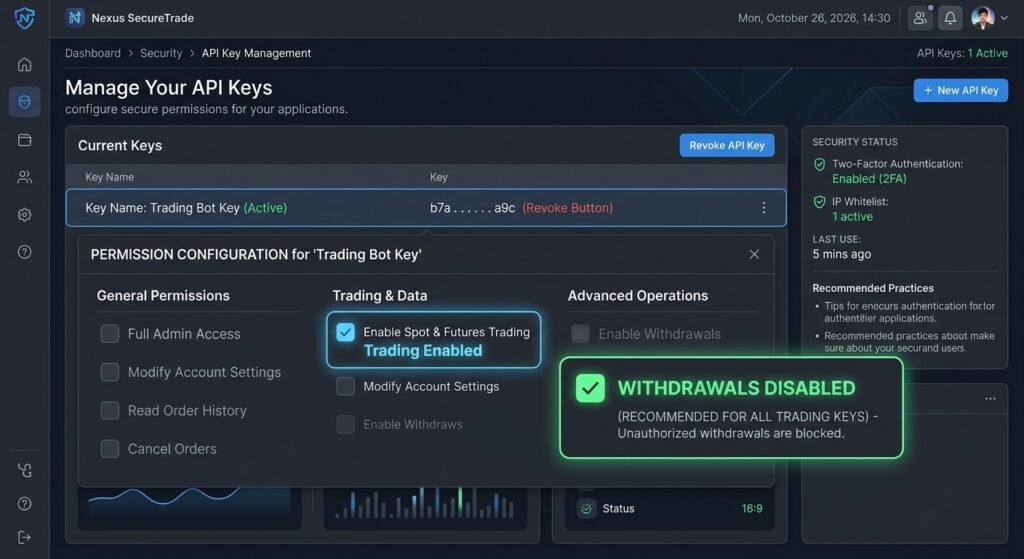
Step 2: Generate “Trade-Only” API Keys
To allow the bot to trade on your behalf without taking custody of your funds:
-
Log into your exchange and navigate to API Management.
-
Create a new API key pair specifically for your trading bot.
-
Crucial Security Action: Enable “Trade” / “Enable Spot & Margin Trading” permissions. DO NOT check “Enable Withdrawals”.
-
Restrict API access to trusted IP addresses provided by your bot platform if available.
Step 3: Link API Keys to the Bot Platform
Copy the generated API Key and Secret Key from your exchange into your chosen bot platform’s settings dashboard.
Step 4: Backtest and Paper Trade (Demo Mode)
Never deploy real capital immediately:
-
Backtesting: Run your AI strategy against historical market data to evaluate win rates, max drawdown, and risk metrics.
-
Paper Trading / Demo Mode: Allow the bot to run live in simulated market conditions for at least 7 to 14 days without risking real funds.
Step 5: Start Small with Live Funds
Once performance is verified in demo mode, fund the bot with a small portion of your trading capital (e.g., 5%–10%) and set clear profit-taking and stop-loss rules.
4. Common Bot Strategies to Deploy
-
AI Grid Trading: Places automated buy and sell orders at incremental price steps within a set range. Ideal for sideways/consolidating markets.
-
Dollar-Cost Averaging (DCA) Bots: Automatically buys fixed dollar amounts of crypto at regular intervals or during dips, smoothing out purchase costs over time.
-
Sentiment & Signal Bots: Uses AI text models to enter positions based on real-world news breakouts or TradingView technical alerts.
5. Non-Negotiable Risk Management Rules
While AI bots offer execution speed and discipline, they cannot predict unexpected black swan events. Protect your capital with these essential rules:
-
Always Set Stop-Loss Limits: Ensure every automated strategy has hard stop-loss limits configured to prevent catastrophic drawdowns during sharp market dumps.
-
Avoid Excessive Leverage: Limit leverage on futures bots to conservative levels (1x–3x max). High leverage can lead to rapid liquidations during sudden flash crashes.
-
Monitor Performance Regularly: Check your bot’s active orders and open positions daily to ensure market regimes haven’t shifted out of the bot’s configured range.
Conclusion
Using AI crypto trading bots enables traders to automate technical strategies, manage 24/7 liquidity, and eliminate emotional decision-making. By selecting proven platforms, locking down exchange API keys with withdrawals disabled, and starting in paper-trading demo modes, you can harness artificial intelligence to enhance your crypto trading operations safely.