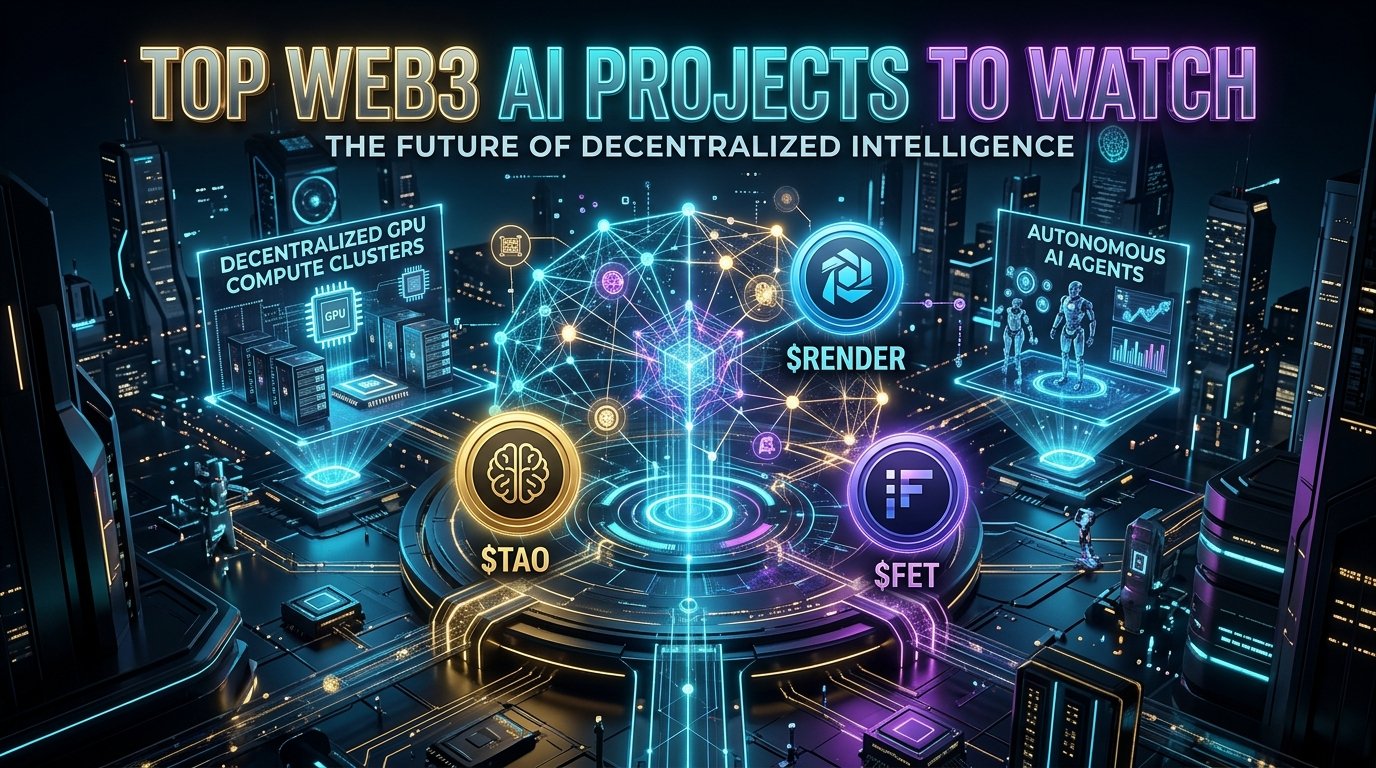
Discover the top Web3 AI projects transforming the cryptocurrency market. Explore decentralized machine learning, GPU compute networks, and autonomous agents.
The convergence of artificial intelligence and blockchain technology has transitioned from speculative narrative to foundational Web3 infrastructure. Decentralized Artificial Intelligence (DeAI) protocols are systematically challenging Big Tech monopolies by offering open-source alternatives for machine learning, GPU computing, and autonomous software agents.
Whether you are tracking decentralized neural networks, crowdsourced cloud infrastructure, or agent-to-agent payment rails, several key projects are leading the sector.
Here is an in-depth breakdown of the top Web3 AI projects to watch, their core utility, and why they matter for the future of decentralized technology.
1. Bittensor ($TAO) – The Decentralized Neural Network
Bittensor functions as a peer-to-peer, open-source market for machine intelligence. Often referred to as the “Decentralized Global Brain,” Bittensor coordinates a network of specialized subnets where individual AI models compete and collaborate to solve complex computational tasks.
-
Core Utility: Incentivizes machine learning development through a unique token-weighted validation system that rewards the highest-performing AI models.
-
Why It’s a Top Project: Bittensor scales decentralized intelligence by allowing developers to plug into specialized subnets ranging from text generation to predictive data analysis without relying on centralized API gatekeepers.

2. Render Network ($RENDER) – Decentralized GPU Powerhouse
As artificial intelligence models scale in size, the global demand for high-end processing hardware (GPUs) continues to outstrip supply. Render Network solves this bottleneck by connecting creators and AI developers who need heavy compute power with node operators who own idle GPU hardware.
-
Core Utility: Powers decentralized 3D rendering, spatial computing, and AI model training workloads at a fraction of traditional cloud provider costs.
-
Why It’s a Top Project: Operating natively across multi-chain infrastructure (including Solana), Render acts as a foundational hardware backbone for the entire decentralized AI and spatial media ecosystem.
3. Fetch.ai / ASI Alliance ($FET) – Autonomous Economic Agents
As part of the Artificial Superintelligence (ASI) Alliance, Fetch.ai builds software infrastructure for Autonomous Economic Agents (AEAs). These intelligent agents possess on-chain wallets and identity credentials, allowing them to execute complex workflows, negotiate contracts, and perform micro-transactions independently.
-
Core Utility: Automates multi-chain decentralized finance tasks, supply chain logistics, and machine-to-machine payment settlements.
-
Why It’s a Top Project: Fetch.ai shifts Web3 from passive token holding to active, automated execution where AI agents manage economic operations 24/7.
4. Akash Network ($AKT) – The Open-Source “Airbnb for GPUs”
Akash Network operates a permissionless, decentralized cloud computing marketplace. It allows anyone with underutilized data centers or spare hardware to rent out compute capacity transparently.
-
Core Utility: Provides instant deployment options for popular AI frameworks and heavy processing workloads (such as Llama and Stable Diffusion models) using top-tier enterprise GPUs.
-
Why It’s a Top Project: Akash provides an open-source, censorship-resistant alternative to centralized cloud monopolies like AWS, Google Cloud, and Microsoft Azure.

5. Virtuals Protocol ($VIRTUAL) – AI Agent Creation & Monetization
Virtuals Protocol provides a modular framework for co-owning, deploying, and monetizing autonomous AI characters, virtual influencers, and interactive gaming agents on chains like Base and Solana.
-
Core Utility: Tokenizes AI personalities and establishes the Agent Commerce Protocol (ACP), enabling bots to execute automated transactions and generate on-chain revenue.
-
Why It’s a Top Project: Virtuals bridges consumer-facing entertainment with autonomous Web3 infrastructure, allowing communities to co-own revenue-generating AI agents.
Top Web3 AI Projects Comparison Overview
| Project Name | Ticker | Primary Focus Sector | Key Market Advantage |
| Bittensor | $TAO | Machine Learning Marketplace | Decentralized global neural network with specialized subnets |
| Render Network | $RENDER | Decentralized GPU Compute | Crowdsourced hardware power for AI training & rendering |
| Fetch.ai (ASI) | $FET | Autonomous Agents (AEAs) | Automated multi-chain execution and machine-to-machine payments |
| Akash Network | $AKT | Decentralized Cloud Infrastructure | Permissionless, open-source alternative to Big Tech cloud providers |
| Virtuals Protocol | $VIRTUAL | AI Agent Monetization | Tokenized framework for autonomous characters and micro-transactions |
Key Risks and Challenges in Decentralized AI
While the growth potential of DeAI is massive, investors and developers must navigate specific sector hurdles:
-
The Latency Gap: Centralized AI models run on tightly integrated hardware clusters (like InfiniBand-linked GPUs), whereas decentralized networks can face minor latency delays across distributed nodes.
-
Infrastructure Scaling: Ensuring continuous hardware availability and robust security across decentralized compute networks remains an ongoing engineering challenge.
-
Regulatory & Governance Alignment: Managing decentralized autonomous organizations (DAOs) and tokenomics across multi-project alliances requires constant cryptographic coordination.
Conclusion
The top Web3 AI projects are successfully decentralizing the core layers of artificial intelligence—from raw GPU compute (Render, Akash) to machine learning intelligence (Bittensor) and autonomous execution (Fetch.ai, Virtuals). By removing centralized gatekeepers, these protocols are building a transparent, user-owned foundation for the future of artificial intelligence.